
News from 2016-01-20 / KfW Development Bank
Is this the beginning of a new world (dis)order?
Discussion about international politics and cooperation
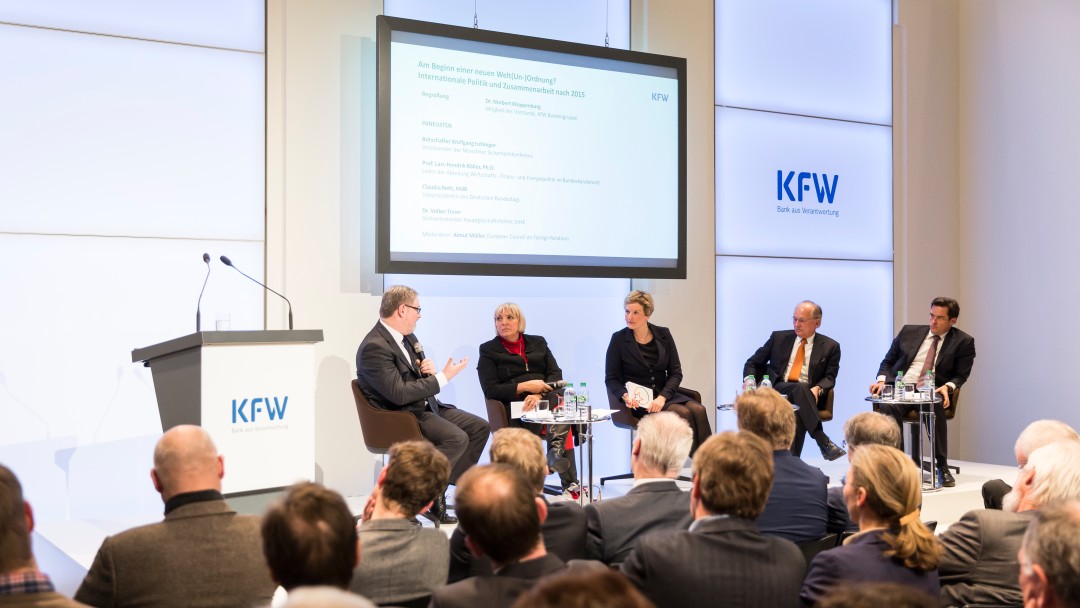
2015 saw summits and the Paris Agreement on climate change, and brought with it large-scale human tragedies in Ukraine, in the Middle East and on refugee routes. These events and their consequences were the focus of the 76th Expert Talk on Globalisation held by KfW in Berlin. The topic: "At the start of a new global (dis)order? International politics and cooperation after 2015" was discussed by prominent experts in the historic banking hall. An audience numbering around 200 experienced a lively debate.
In his welcoming address, Dr Norbert Kloppenburg, Member of the Executive Board of the KfW Group, underlined the need for international cooperation in a world where our order of values and peace is under threat. He stated that KfW is meeting these challenges by making an important contribution to stabilising emerging and developing countries, a contribution that today also includes combating the causes of migration and flight.
Global uncertainty and fragility have increased
Ambassador Wolfgang Ischinger, chairman of the Munich Security Conference, emphasised the huge increase in volatility on our planet, arguing that it will result in international movements of refugees becoming a permanent phenomenon. Overall, uncertainty and fragility have been on the rise the world over, making it harder to predict what the coming year will bring and increasing the importance and value of diplomacy. 2016 will be a year in which the course of the future is set, he concluded.
Prof. Lars-Hendrik Röller, Director General of the Economic and Financial Policy Division of the German Federal Chancellery, underlined the fact that not only international challenges, but also the crisis within Europe remain unresolved. He pointed out that two of the most important pillars of the EU, Schengen and the euro, are still at risk. According to Röller there is a need to reflect on the western community of values, a topic that was also addressed at the G7.
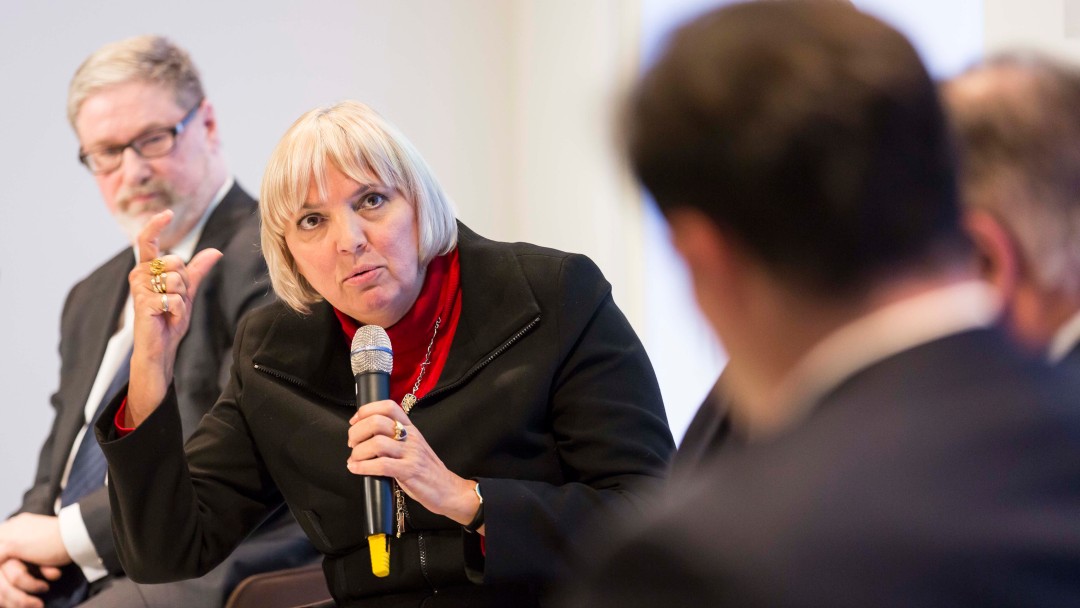
Roth: Development cooperation must not be exploited
Bundestag member Claudia Roth, Vice-President of the German Bundestag, also addressed the rising danger of populism and a resurgence of nationalism within the crisis-ridden Europe. What is needed, she argued, is a strong and united Europe. Foreign policy cannot be simply guided by national considerations for then it cannot be sustainable. In relation to the question of refugees, she argued that development cooperation should not be instrumentalised as had been the case with the stance towards the African Union at the Valletta summit.
Dr Volker Treier, Deputy Chief Executive of the Association of German Chambers Industry and Commerce (DIHK), deplored the lack of orientation in the German economy. He posed the questions: What do Germany and Europe stand for? What is morally permissible? Time and again, he continued, investments by German companies had also stabilised countries that are not "white-as-snow democracies". But business also had a role to play in a value-driven foreign policy. This was, he said, particularly clear in the textiles sector, which has committed itself to sustainability along the whole supply chain.
Overall, the debate showed that the world is facing major challenges this year. The experts were unable to offer any easy solutions. The quest for ways out of the crisis will have to continue.

Share page
To share the current page content with your network, click the button below and then select the desired option in the dialog box.
Note on data protection: By clicking the button, your browser's sharing function is used. If you select an external provider when sharing, personal data may be processed by the provider. Please read our data protection principles for more information.
Your browser does not support sharing with external services.
Alternatively, you can also copy the short link: https://www.kfw-entwicklungsbank.de/s/enzBWrMC.BSKB
Copy link Link copied