
Tip: Activate javascript to be able to use all functions of our website
Tip: Activate javascript to be able to use all functions of our website

As of: 03/2024
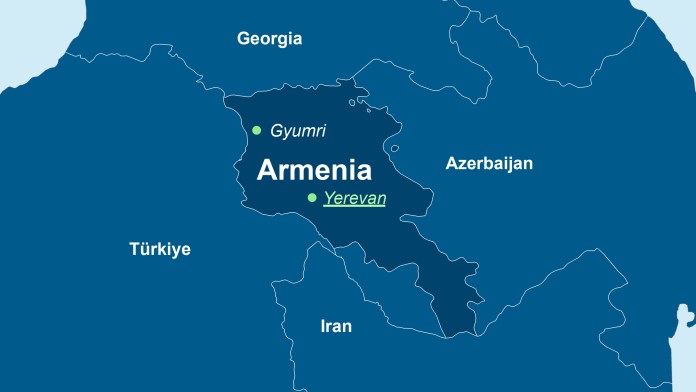
Promoting energy efficiency and using renewable energies are currently important topics for the German Armenian Fund (GAF) of the Armenian Central Bank. GAF has been in existence since 1998 and is a real success story: the Armenian Central Bank provides funds from international donors to local commercial banks through GAF so that they can grant loans for small and medium-sized enterprises (SMEs) in various key sectors. The special feature of this system: the loans are issued in the Armenian national currency dram. This makes it easier for many companies to repay. In the meantime, the expansion of renewable energies and the improvement of energy efficiency are important focus areas for GAF. Commissioned by the German Federal Government, KfW has been supporting GAF since its founding.
So far, over 75% of Armenia’s energy comes from one nuclear power plant and several thermal power plants, but the corresponding energy sources need to be imported. As a result, the country is heavily dependent on imports, in particular from Russia and Iran. With two exceptions, the current power plants date back to the period before independence in 1991. They are no longer state of the art.
Armenia wants to diversify its energy supply and thereby become less dependent on fossil fuel imports. In addition to hydropower, which makes a further contribution to Armenia's energy mix, solar power is particularly suitable as a sustainable energy source with great potential.
Moreover, more efficient use of energy is also a way to become less dependent on fossil fuels and save greenhouse gases. However, many small and medium-sized enterprises (SMEs) work with machines and operate in buildings that date back to the Soviet Union. These are outdated and require a lot of energy, but SMEs lack the means to invest in innovation. They also usually do not have access to suitable loans.
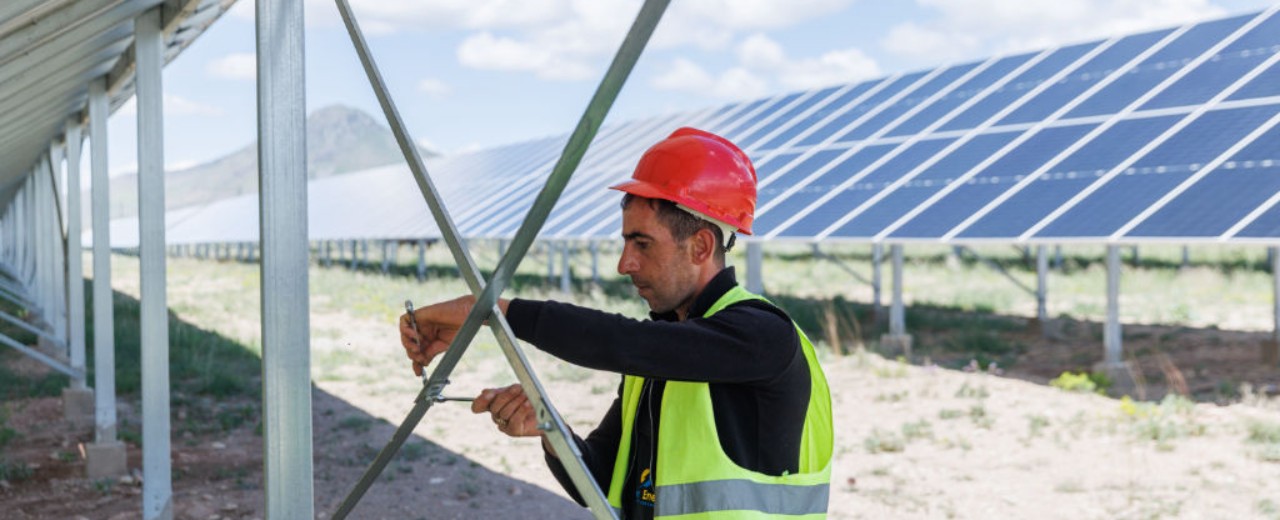
The GAF, based in the Armenian Central Bank, offers a solution here: it provides funds for Armenian commercial banks to provide loans for investments in renewable energy and energy efficiency measures. As GAF provides these funds at long maturities, reasonable interest rates and in local currency, commercial banks can provide sub-loans on better terms than if they had to refinance them via the financial market. What makes these funds particularly special is that the borrowers receive them in dram and also pay their instalments in dram. This makes it easier for many SMEs to access loans. The Armenian Central Bank plays an important role here as it bears the exchange rate risk, even though the KfW loans are issued in euros. Since GAF was founded, KfW, commissioned by the Federal Ministry for Economic Cooperation and Development (BMZ), has provided more than EUR 450 million, which has been used several times in the meantime.
GAF Director Gayane Khachatryan emphasises: “The GAF programmes help save greenhouse gases, thereby promoting climate protection.” With the help of the GAF loans, companies are investing in energy efficiency, for example in better insulation for buildings or modern heating and ventilation systems. The energy-efficient modernisations reduce the costs for companies.
GAF is now also working with other donors, such as the World Bank, the European Development Bank (EIB) and the Asian Development Bank (ADB). KfW has so far provided more than EUR 111 million for SME promotion, EUR 72 million for housing promotion and EUR 50 million for agricultural promotion.
In the areas of renewable energies and energy efficiency, there is still a great demand that the Armenian financial market alone cannot yet meet. Whilst the initial focus was on hydropower and solar thermal energy, since 2018 the emphasis has been on photovoltaic systems and energy efficiency measures in SMEs. Between 2018 and 2025, KfW has provided loans totalling EUR 158 million to the Central Bank on behalf of the BMZ for this purpose. The GAF has already been able to use the funds provided by KfW on several occasions. Their impact is multiplied through their revolving nature.
To date, the loans have been used to build large grid-connected PV systems with a capacity of up to 5 megawatts each, resulting in a total installed capacity of almost 120 megawatts. In addition, there are smaller PV systems in private households and SMEs with a total capacity of over 70 megawatts. This ensures that Armenia’s high levels of solar radiation are utilised to the full.
The GAF-funded programme for residential buildings has enabled new energy efficiency standards to be introduced in Armenia. This sets the benchmark for the entire construction sector. The GAF also funded the very first photovoltaic systems in Armenia. The nearly 200 megawatts generated by the solar installations funded in the most recent programme phases account for around 50% of the total newly built generation capacity for the period 2018-2025. Greenhouse gas emissions are being reduced: these facilities are already saving over 140,000 tonnes of CO2 per year. The country’s vast renewable energy resources are now being utilised more effectively, and the country’s growing energy needs are being met in a more sustainable way.
The GAF programme uses funds provided by the BMZ to finance technical support from an experienced international consultant. This has helped to ensure that international technical, environmental and social standards have been introduced for investments in photovoltaics in the Armenian market.
The project contributes to the achievement of these following United Nations Sustainable Development Goals:
/SDG-8_EN_Responsive_1080x608.png)
/SDG-9_EN_Responsive_1080x608.png)
/SDG-12_EN_Responsive_1080x608.png)
KfW Group
KfW Development Bank
Country sector Europe/Asia

/SDG-7_EN_Responsive_1080x608.png)

Share page
To share the current page content with your network, click the button below and then select the desired option in the dialog box.
Note on data protection: By clicking the button, your browser's sharing function is used. If you select an external provider when sharing, personal data may be processed by the provider. Please read our data protection principles for more information.
Your browser does not support sharing with external services.
Alternatively, you can also copy the short link: https://www.kfw-entwicklungsbank.de/s/enzByqZh
Copy link Link copied