Tip: Activate javascript to be able to use all functions of our website
Tip: Activate javascript to be able to use all functions of our website
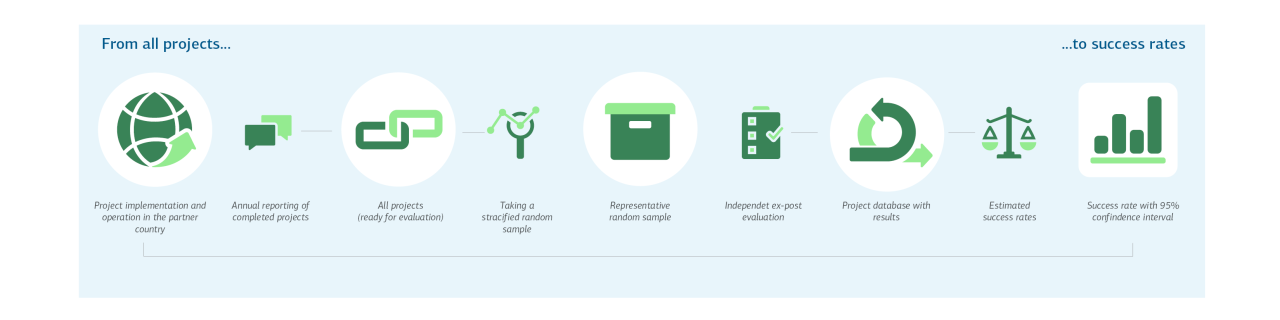
Until 2006, all completed projects were evaluated ex-post (full survey). Since 2007, FC Evaluation has drawn an annual random sample, stratified by sector, from the population of projects ready for evaluation. Ex-post evaluations are carried out for all projects in the sample. This procedure ensures the statistical representativeness and informative value of the evaluations for the FC portfolio and maintains independence in the selection of projects to be evaluated. With over 100 projects ready for evaluation each year and a sample size of over 50%, the effectiveness of all projects can be reliably estimated. The results are summarised and published in biennial evaluation reports.
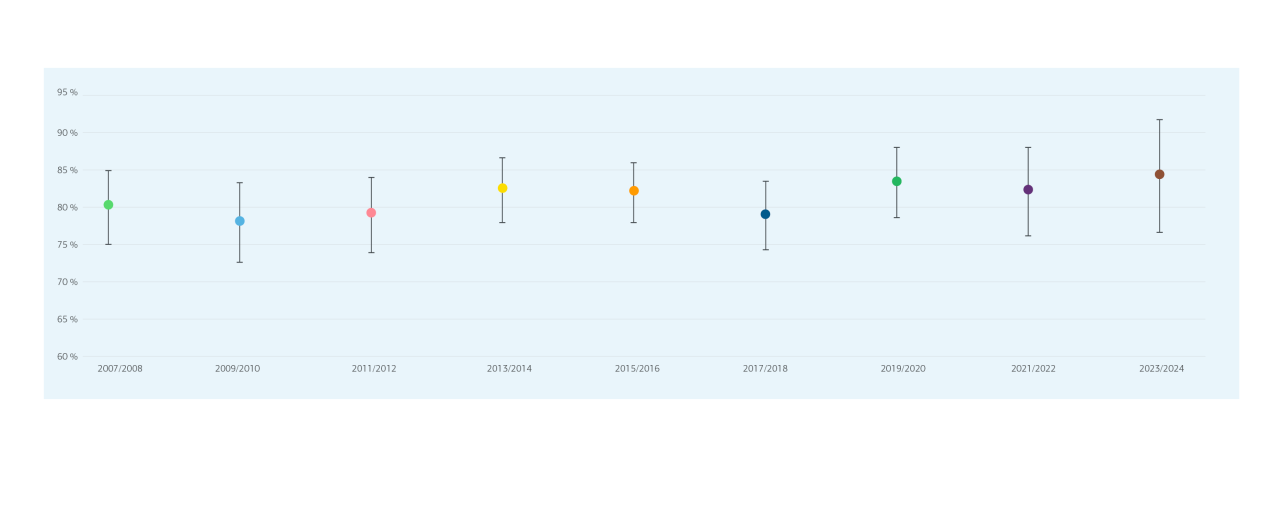
The success rate, i.e., the proportion of projects rated at least 3 (moderately successful), is 85%. The current success rate is therefore above the long-term average success rate of 81% from 2007-2024 and is in line with the slightly positive trend over the past 18 years.
Thanks to the representative sampling, this success rate can also be applied to non-evaluated projects and thus to all 268 FC projects from the evaluation period. However, there is a certain statistical uncertainty here, which is expressed by the confidence interval: The success rate of all (evaluated and non-evaluated) projects in the 2023-2024 reporting period is between 77% and 92% with 95% certainty.
Estimated success rate and 95% confidence interval

In summary: A total of 140 financial cooperation projects were evaluated in the years 2023-2024. Of these, 65 came from the 2023-2024 sample and 49 from previous samples, while 26 were bundled. We additionally consolidate projects when they can be coherently assignable an evaluation of the sample to be conducted – even if they are not themselves part of the sample. Criteria for this would include, for example, spatial and temporal proximity to projects from the sample.
Which projects have been evaluated in the past two years? How successful were they? Detailed information can be found in the current 18th evaluation report